Rd.1 BEIJING RACING REPORT BY MARCUS SIMMONS
One week before the opening round of the FIA Formula E Championship in Beijing, Takuma Sato had no idea he would be competing. Just six days after learning that he would be guiding a pair of Amlin Aguri racers around the track in the shadow of the Bird’s Nest Stadium, he had earned two points for setting fastest lap in the inaugural electric single-seater race.
Of course, the ‘Aguri’ name needs no introduction. Japanese racing hero Aguri Suzuki, whose Super Aguri team became a crowd-favourite Formula 1 underdog with Sato from 2006-08, is the patron of Amlin Aguri – and there are plenty of Taku’s old friends from Super Aguri on the staff.
“I was very interested in electric cars – Formula E is very different and shows the future is coming,” said Sato. “It’s quite fascinating. I’d already had a great chance to meet my old friends from the Super Aguri days and join a Formula E open test at Donington in England, where all the teams are based. That was simply because Antonio Felix da Costa, who is supposed to be driving for the team with Katherine Legge, couldn’t make it. I had a call from Mark Preston, who runs the team, and he asked if I could help and I said by all means. So I flew into the UK to drive at Donington – my first time there since my British Formula 3 Championship winning season of 2001!
“Then I went straight back to the States for the last part of IndyCar races at Sonoma and Fontana, and a few days before Beijing I had another call – it was really last-minute but there was an opportunity to race with the team in China. Two nights before arriving in China I was in Chicago doing a sponsor appearance for ABC Supply. Then it was straight to Japan for one night – 20 hours or something in the country, before I headed off to China! It’s only a one-race deal because it’s unknown how the winter test programme will happen in IndyCar, and whenever I race I want it to be with 100 per cent preparation.
“I was really happy to help the team, especially as Aguri-san, Mark, Peter McCool the technical director and Gerry Hughes my engineer were all there from Super Aguri days. Gerry was also my engineer at Rahal Letterman Lanigan Racing in IndyCar in 2012. Some of the mechanics were also the same. But of course we had very minimum preparation to go to Beijing, so I knew it was going to be a tough task for us. I was excited and hoping we would be competitive, but at the same time I had to be realistic, knowing that other top teams had been testing for a long time and would be tough to beat.”
The concept of Formula E is based on one-day meetings on Saturday, encompassing free practice, qualifying and the race, but this time the teams were allowed a short shakedown session on Friday because it was the first event. Not only this, but because of battery life each driver has two cars for each race, with car changes taking place roughly halfway through the race. Plenty of strategy here, but unlike IndyCar-style refuelling and tyre changes, with perhaps a wing adjustment, it’s a completely new car.
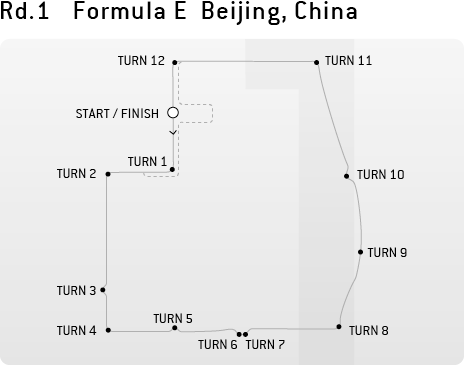
“It was nice to come to the paddock and see so many familiar faces,” said Taku, “not only from Formula 1 but even from my Formula 3 days. The Friday session was very valuable for us – we went through quite a few things, but we were only able to shake down one car. The track is interesting, with a nice layout, a combination of medium-long straights and heavy braking, with chicanes and typical 90-degree corners. The chicanes are very tight, impossible to go two-wide. Because the track is based on the Olympic stadium it’s quite smooth, unlike a typical IndyCar real street circuit!”
Into practice, Sato and the Amlin Aguri team went through the usual motorsporting pattern of checking ride height, springs and aero, but the new dimension here was energy management. OK, you have to work out fuel use in conventional racing, but here it’s far more complicated. “Qualifying is quite straightforward,” said Taku, “because it’s maximum power. But the motor and battery gets quite hot so you can only do two timed laps. Doing a 25-lap race with two cars is a lot of difference. You have to use low energy at some places on the track, and then flick up to more power on the straights. Power mapping is extremely important – the big challenge in Formula E.
“In second practice we had some technical issues and unfortunately I could only do two timed laps, and I wasn’t able to jump in the other car so we couldn’t do a qualifying simulation.”
Even the tyres posed a new challenge, being treaded Michelin rubber. “They are extremely low profile, with 18-inch wheels,” said Sato. “It has quite a low working range, and the tyre grip is already there so you don’t need to warm them up. They give great response, but the sidewalls are so stiff due to the low profile that the handling is quite tricky. The difficult part is braking – they have carbon brakes, but you need a very fine temperature control. If you can’t get that right you have a nightmare, which is the case with this car due to there is no cooling duct for brake.
“I only had one shot at a hot lap in qualifying and had a traffic – the car in front made a mistake, aborted the lap but kept on the racing line. I had to brake and overtake it into a high-speed corner.”
That left Taku 14th, although he moved up to 13th on the grid due to a penalty for Sebastien Buemi. From there, it was more or less straight into the race. A good start put him immediately ahead of Jerome d’Ambrosio on the outside of Turn 1, but then a sideways moment ahead caused a chain-reaction of three car wide at Turn 2. Bruno Senna just managed to avoid hitting Sato, but hit the kerb on the inside and the damage forced him out, causing a safety car. After this, there was some great battling with Oriol Servia and Nelson Piquet Jr on the fringes of the top 10.
“The race was quite exciting,” said Sato. “You could see some of the cars conserving energy and some aggressive. But my radio was broken so I had zero communication – this is crucial in Formula E racing because the cars have no telemetry. You have to radio back to the team to tell them how much power you are using, but we couldn’t have this conversation so they were having to show my predicted energy usage on the pit board. I knew I was ahead of my target, and that possibly I could go one lap further than the others to stretch the first stint – then when I jumped in the second car I would have more energy to maybe charge in the second half. Then unfortunately I had an electric issue and I had a power cut, and the car stopped. All the lights were blinking on the dash so I knew there was some power. I tried to reboot a few times but I got pushed into the escape road by the marshals. Finally the car came back! But by that time I was already laps down.
“I jumped into the second car, so now I finally had a working radio, with a fresh battery. I was able to catch people and I really enjoyed the race, and it was nice to compete at a good level. Unfortunately on the last lap I had to stop with an electrical issue again.”
On the lap before though, helped by having a relatively short stint in the second car and more battery life to use, Taku had set the inaugural fastest lap. “That was nice,” he said. “I get two points and the first ever Formula E fastest lap!”
So, a good finish, but whether there are any more Formula E races for Sato is uncertain, especially as he is hoping to cement an IndyCar deal soon for 2015 and possibly begin work on testing in November. “I believe that the fans enjoyed the race, perhaps more than they expected,” he said. “It was quite fun, challenging, and I believe in a year’s time it will be very exciting. I really appreciated the chance to work with the Amlin Aguri team, and even if I’m not driving I will still be supporting them in many ways. If I can help in any way I will. I’m looking forward to the team improving and performing!”