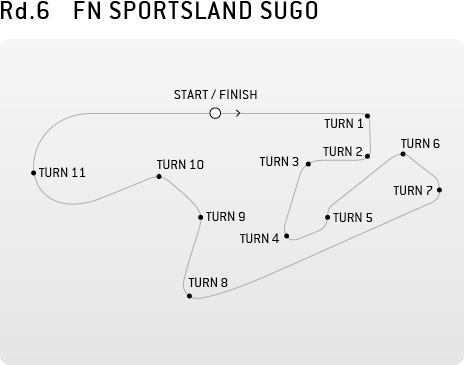
Rd.6 FN SPORTSLAND SUGO RACING REPORT BY MARCUS SIMMONS
Just a couple of days after the finish of the IZOD IndyCar Series season, Takuma Sato found himself on an aeroplane to Japan to continue his racing – this time in the Formula Nippon Championship.
It was a tough baptism for Sato, who had only a few laps of dry running under his belt in a Formula Nippon car, and who had never seen the Sugo circuit on which the race took place. That he came away from the weekend with ninth place, on the lead lap after a race that took place in bad weather conditions, was highly creditable.
Of course, the work began for Taku before he stepped into the cockpit of his Team Mugen Swift-Honda chassis. (Like IndyCar, Formula Nippon uses spec chassis, in this case the California-built Swift, but there is open engine competition, with Honda competing against Toyota).
“We had a few charity events and autograph sessions,” he said. “And for my With You Japan campaign I invited some kids from the nearby area that was devastated in the 2011 earthquake. A big thanks to all the volunteers and fans who supported the project – it was fantastic.”
Again like IndyCar, the drivers include some of the best from the region, along with top international talent. “It’s an incredibly competitive series,” continued Sato. “Some of the drivers have been a long time in the series and are extremely good, and there is strong up-and-coming talent as well. And there’s Andre Lotterer – we competed together in my British F3 days in 2001 and now he’s a big star in Japan and a double Le Mans 24 Hours winner.
“All I could do was gather information about the Sugo circuit before I went, so I watched video footage of the last couple of Formula Nippon races there. It’s a good circuit, very challenging, with a lot of up-and-down, and big bumps on the very high-speed corner so the car is bottoming out and easy to lose control. This last corner is very impressive – the apex is 220km/h and you’re pulling over 4g. Because the Swift is a wing car, it has a very high level of downforce and the cornering speeds are very fast.”
Unfortunately, Taku’s acclimatisation to his Team Mugen-run car was further hampered when Friday’s half-hour practice session was run on a slippery track – although he went fourth fastest. “We started on rain tyres,” he said. “We did a few runs and I moved to dry tyres, but only did two laps on them. So for me it was not very productive, although it was a good start as far as adapting to the car and the track.
“There was only one hour of practice on Saturday before qualifying, so my time in the car was incredibly short. It was Team Mugen’s first time with a two-car team and even my team-mate Naoki Yamamoto, who is known a very quick young guy, was struggling because our cars were not handling well.
“So it was a hectic time for the team but we managed well. Naoki was concentrating on his own set-up whereas I was running with a clean sheet of paper and we tried to gauge a completely different set-up philosophy. It was a good test session, even if the result did not necessarily reflect what we did, and we made a lot of progress.”
Come qualifying, Sato narrowly failed to make to make the top 13 to graduate to the second phase – missing out by just a few hundredths and ironically pipped by his own team-mate, Yamamoto. That meant he would start the race 14th: “It was a little disappointing because the configuration of the car was not exactly as I expected. It was a shame but it shows how competitive this series is.”
Raceday was very wet: “There was a half-hour practice session and I said, ‘OK, now we have a very good chance.’ The rain would help me a lot bearing in mind my lack of experience of the car. I was quite happy to see the weather forecast get worse and worse!
“But in practice our car was shocking. Naoki was at the bottom of the timesheets, and I was two and a half seconds off the pace – it was purely undriveable, so nervous and with no stability, so we had to do a radical set-up change that we hoped would work well for the race.
“The race was soaking wet, with the rain getting heavier and heavier. After racing in IndyCar, I was looking forward to a standing start but we had to start behind the safety car. It reminded me of the Japanese Grand Prix at Fuji in 2007 with Super Aguri – there was zero visibility at the end of the straight. It was so bad, and I wasn’t even sure they could start the race…”
But they did, and after the field had played themselves in Sato was picking off the cars ahead. When Tsugio Matsuda lost a wheel in the closing stages, Taku had worked his way through to seventh place, on the tail of Brazilian ace Joao Paulo de Oliveira. “After the cars spread out and there was some visibility I picked up some good pace and I was able to gain some positions,” said Sato. “It was a hard, long race, and you had to keep concentration. The track was incredibly slippery and it was like we were skating for the whole two hours.
“By the time I got to JP in front, I was confident for the restart. But off the final corner there was a car spinning in front of us, the whole pack was in a mess and I instantly saw double-yellow caution lights on the bridge. I thought the restart was delayed and I started to back off, and 200 metres later it went green… It was too late to pick up acceleration and I lost positions into the first corner.”
Worse still, Taku had to go wide in avoidance as Lotterer collided with Kazuki Nakajima while trying to take second place: “Andre was in the middle of the road, moving left, so I chose right and his car came back to the right. I really had to avoid him and lost another position.”
So Sato came home ninth, not a bad result on his Nippon debut when he was in at the deep end (literally, in the conditions!). And he is already looking ahead to the next race, at Suzuka on November 4 – a track he knows very well, of course.
“We raced hard in what wasn’t a very comfortable car,” he said, “so in terms of the weekend we had, the result was disappointing but not too bad. I hoped to finish better in the race, but it just didn’t go as we wished.
“But it was fun, my first-ever Formula Nippon race and the fans were great! It was very cold, with heavy rain, but they had a very good day. As a team, we learned a lot and gained a lot of experience, so hopefully we can carry the momentum to Suzuka, where the team are confident they can be very competitive.”